In this field note
Read the clock on the tariff
Take the rate schedule that applies to your meter. Find the time zone, weekday and weekend rules, seasonal dates and each price per kWh. Then line up those bands with when the miner actually runs. The EIA explains why electricity prices vary with the time of use. The prices below belong to a model tariff, so replace them with your own.
Price the two parts of the day
| Model tariff period | Load × time | Energy | Energy charge |
|---|---|---|---|
| Off-peak at $0.10/kWh | 3 kW × 20 h | 60 kWh | $6.00 |
| Peak at $0.30/kWh | 3 kW × 4 h | 12 kWh | $3.60 |
| Full day | 24 h | 72 kWh | $9.60 |
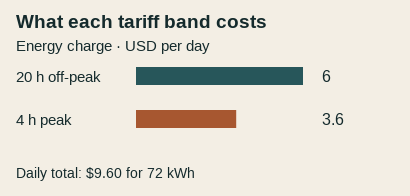
The price to enter in a flat-rate calculator for this operating schedule is $9.60 ÷ 72 kWh, or about $0.1333/kWh. Averaging the two sticker prices gives $0.20/kWh and a $14.40 estimate. That shortcut overstates this day by $4.80 because most of the electricity was bought off-peak.
Compare a peak-hour pause
If the miner draws zero for all four peak hours, the energy charge falls to $6.00. It also gives up four hours of work. At a steady 100 TH/s, that leaves a daily average of 83.33 TH/s. Use the worker downtime calculation to model a different schedule.
A pause need not mean zero draw. Suppose the meter still shows 0.2 kW for controls and cooling during the four-hour pause. That adds 0.8 kWh and $0.24, bringing the day to $6.24. The saving against continuous running is then $3.36. Compare it with the expected value of work forgone over those same four hours.
Carry the result onto a real bill
Use a meter or billed interval data if power varies across the day. Work out kWh and cost for each interval first. For a monthly estimate, add the actual weekdays, weekends and tariff changes rather than multiplying one convenient Tuesday by 30.
Check the bill separately for a fixed fee, demand charge or tax. A per-kWh result alone cannot price a charge tied to the highest measured demand. The mining energy cost guide and mining calculator use wall draw as the starting point. Keep a copy of the rate schedule with your inputs so another reader can reproduce the bill.
Frequently asked questions
Should I enter the average of my two tariff prices?
Weight each price by the kWh bought at that price. If the prices differ, a simple average works only when consumption is evenly split between the two bands.
Does stopping for four hours always save the whole peak energy charge?
Only if the load falls to zero for those hours. Include standby draw, cooling and any demand or fixed charges that still apply.
Which price belongs in the calculator after I pause at peak?
If the miner runs only in the off-peak band and uses zero power during peak, enter the off-peak price. Add any measured standby energy at the actual peak rate.
Put it to work
Mining calculatorSources are listed above. This guide explains the mechanics; it is educational information, not a recommendation to invest or buy mining equipment.