
In this field note
Start with a shift you can account for
Take one worker, one 24-hour period and a confirmed shutdown. Assume the machine held 100 TH/s while running. A maintenance record puts it offline from 14:00 to 15:00 UTC.
| Period | Hours | Rate | Rate × hours |
|---|---|---|---|
| Before shutdown | 14 | 100 TH/s | 1,400 TH/s·h |
| Maintenance | 1 | 0 TH/s | 0 TH/s·h |
| After restart | 9 | 100 TH/s | 900 TH/s·h |
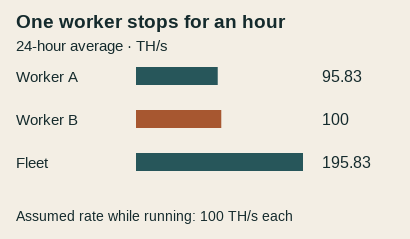
Divide 2,300 TH/s·h by the full 24 hours. The worker averaged 95.83 TH/s. Dividing by 23 gives 100 TH/s, its running average. Both numbers have a use. Write the denominator beside the number so the next shift knows which question it answers.
Add the workers before estimating the fleet loss
A second 100 TH/s worker ran the whole day. Its contribution is 2,400 TH/s·h. Together the two machines delivered 4,700 TH/s·h, or 195.83 TH/s across 24 hours. Against a two-worker baseline of 200 TH/s, the fleet shortfall was about 2.08%. Applying the affected worker’s 4.17% loss to the entire fleet doubles the estimated impact.
If a machine ramps slowly after restart, record another segment at its observed rate. A worker that spends two hours at 50 TH/s contributes the same work over those hours as one hour at 100 TH/s and one hour stopped. Those patterns call for different maintenance decisions.
Separate a monitoring alert from a confirmed stop
Braiins documents how worker monitoring and alerts operate. Check the pool’s observation period and the miner’s uptime, restart log or known maintenance interval. A silent monitor, an unavailable network connection and a machine powered off can leave similar gaps. Mark the interval unknown if you cannot distinguish them.
The mining calculator applies uptime to both hashrate and power. For a worker drawing zero during shutdown, enter 100 TH/s and 95.83% uptime, plus the measured running watts. If you enter the daily average of 95.83 TH/s, set uptime to 100% and use average wall watts over the entire day. Mixing daily-average hashrate with running watts gives the wrong energy bill. Electricity needs its own record. A disconnected worker may still draw power, as the energy cost guide explains.
Frequently asked questions
Is a missing graph point an hour of downtime?
A missing sample only tells you the system has no reading. Confirm the interval with a device or maintenance record before entering zero.
What if the miner comes back at half speed?
Split the day again. Multiply each period’s hours by the rate delivered during that period, add the results and divide by the full window.
How much fleet capacity does one lost worker-hour represent?
For two identical workers expected to operate 24 hours each, one confirmed lost worker-hour is 1 out of 48 expected worker-hours, or about 2.08%.
Put it to work
Mining calculatorSources are listed above. This guide explains the mechanics; it is educational information, not a recommendation to invest or buy mining equipment.