In this field note
Take two readings at the same boundary
Record the operating mode, watts at the wall, measured hashrate and observation period. Use a stable period after each change. If one run includes startup or an unusually hot afternoon, note that beside the result. Keep cooling loads inside both measurements or outside both.
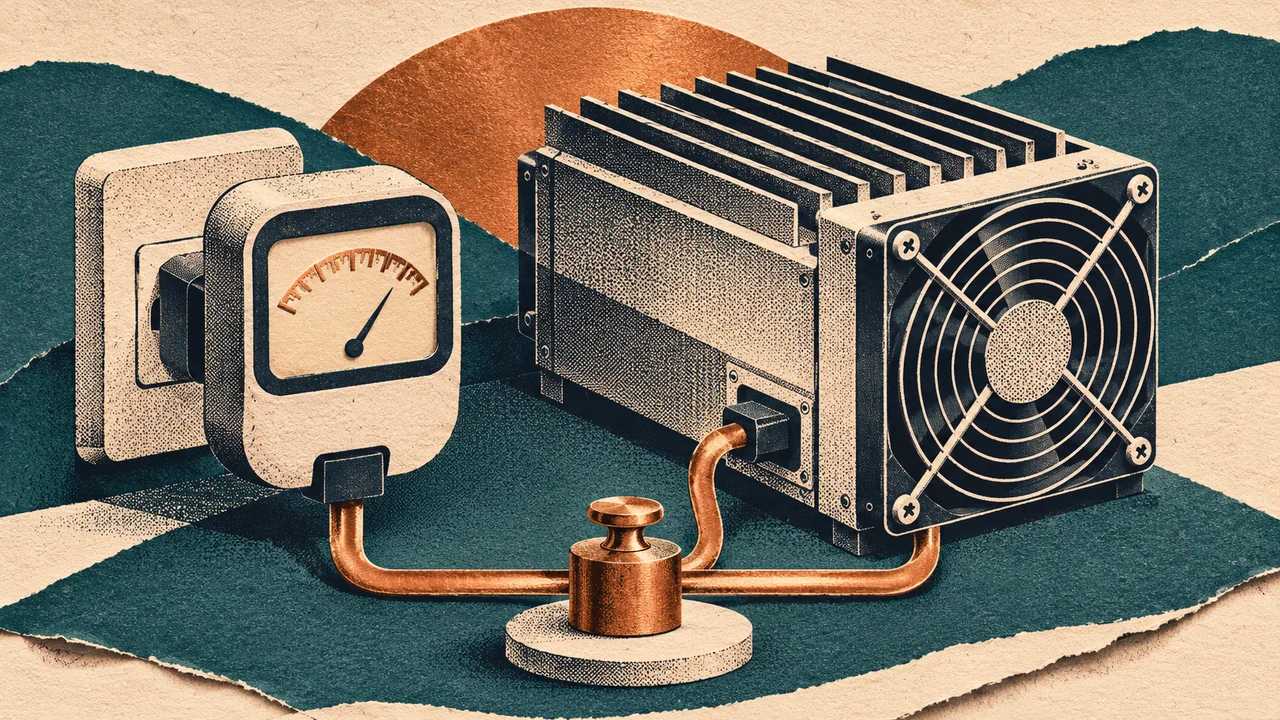
A watt is a joule per second. Divide joules per second by terahashes per second and the seconds cancel. That leaves joules per terahash. The EIA’s explanation of power and energy also explains why a power reading needs a duration before you can use it on a bill.
What the two settings deliver
| Illustrative setting | Wall draw | Stable hashrate | Energy per TH | Energy in 24 h |
|---|---|---|---|---|
| A | 3,000 W | 100 TH/s | 30.00 J/TH | 72.0 kWh |
| B | 2,700 W | 95 TH/s | 28.42 J/TH | 64.8 kWh |
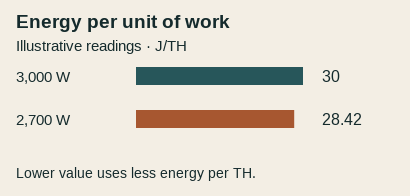
Power fell by 10%. Hashrate fell by 5%. Energy per terahash improved by about 5.26%. The lower setting saves 7.2 kWh over a full day. At an assumed flat price of $0.10/kWh, that is $0.72 less electricity per day. These are worked inputs, not measurements of a particular machine.
You save $0.72 in this example and give up the work delivered by 5 TH/s over the day. To compare operating margins you still need the value of that lost work under your own pool terms. The mining calculator lets you test those assumptions.
Avoid a false efficiency improvement
Keep the hashrate source consistent across both settings. A short pool estimate can swing because of the shares found during that window. Braiins describes the distinction between nominal and effective hashrate. Comparing yesterday’s local rate with today’s five-minute pool rate can move your calculated efficiency even if the machine behaves identically.
Treat a zero-rate interval separately. Dividing power by zero cannot give a meaningful J/TH result. Record the idle energy in kWh instead. For a purchase comparison, the hardware guide covers other constraints that a single efficiency figure leaves out.
Frequently asked questions
Can I compare a chip rating with power at the wall?
Use a consistent boundary for both readings. Wall power includes losses and loads that a chip specification can exclude.
What does J/TH tell me about revenue?
It measures energy per unit of work. Revenue also depends on the amount of accepted work, the pool terms and the reward rate.
How do I convert watts and TH/s to J/TH?
Divide measured wall watts by stable TH/s from the same run. At 2,700 W and 95 TH/s, the quotient is 28.42 J/TH.
Put it to work
Mining calculatorSources are listed above. This guide explains the mechanics; it is educational information, not a recommendation to invest or buy mining equipment.