In this field note
Bitcoin mining uses computing work to compete for the right to add the next block of transactions. A successful block can earn its miner newly issued bitcoin and transaction fees. Running a machine also creates costs, whether or not it earns enough to cover them. Understanding both sides is the useful starting point for a beginner.
You can learn the process and model a machine before buying equipment. This guide follows the path from a block candidate to a possible payout, then shows which information a first cost estimate needs.
What the machine actually does
Mining software prepares a candidate block and sends work to hashing hardware. The hardware repeatedly changes allowed fields and calculates a hash of the block header. A qualifying result must be at or below the network target. Finding one takes unpredictable work; checking the result is straightforward. The Bitcoin developer mining guide describes this workflow.
A valid proof of work is only part of a valid block. Full nodes independently check the transactions and the other consensus rules. A miner cannot make an invalid payment acceptable simply by attaching enough computing work. See the Bitcoin block chain guide for the distinction between producing and validating blocks.
Think of the repeated hashing as many independent attempts. An unsuccessful attempt does not bring the next one closer to success. Our guide to Bitcoin hashing explains why changing a small input produces a very different result.
Hashrate and difficulty explain your share
Hashrate measures attempts per second. A terahash is one trillion hashes, so a hypothetical 100 TH/s device attempts about 100 trillion hashes each second while operating at that rate. That large number says little about income until it is compared with the difficulty of finding a block.
On Bitcoin mainnet, difficulty adjusts every 2,016 blocks toward a network average of about ten minutes per block. The adjustment is based on block timestamps, so it is not a fixed appointment every two calendar weeks. Individual blocks can arrive much sooner or later. These rules are documented in the proof-of-work section of the developer guide.
For a simplified illustration, a miner with one millionth of the network hashrate has about a one-in-a-million chance of finding any particular next block. At an assumed 144 network blocks per day, that is one expected block in roughly 6,944 days. This is probability arithmetic with a frozen network share, not a countdown: a block might arrive tomorrow or never during the machine’s useful life.
Where a mining payment comes from
The block reward combines the subsidy, which creates new bitcoin, and the fees from included transactions. The subsidy declines according to the halving schedule. Fees vary with the transactions included in a block, so a fee spike should not become a permanent revenue assumption. Read Bitcoin halvings and transaction fees for those two separate mechanisms.
As issuance eventually ends under the current rules, the incentive for mining is expected to come from transaction fees. This describes the protocol’s intended structure; it does not establish what future fee revenue or mining economics will be. The Bitcoin FAQ explains mining incentives and issuance.
Why beginners encounter mining pools
A pool accounts for work from multiple miners and distributes payments under its own rules. It can reduce the variation in an individual miner’s receipts, while charging fees and introducing dependence on the operator. Smaller payments can still fail to cover electricity.
Keep three events separate: submitting accepted work, being credited in the pool account, and receiving bitcoin in your wallet. A minimum withdrawal threshold or payout schedule can delay the last event. Our mining pool guide explains shares, payment methods, and the questions to ask before connecting a machine.
What a practical setup needs
Bitcoin mining generally uses specialized ASIC hardware. A phone app or ordinary computer should not be assumed to provide an equivalent source of Bitcoin hashpower; establish whether a service actually mines, remotely controls equipment, or sells a contract. The Bitcoin FAQ on getting started with mining describes the move to specialized equipment.
A usable setup also needs suitable electrical capacity, cooling, connectivity, and a payout destination. Compare equipment with the same algorithm and operating conditions using our hardware guide. An appealing specification does not establish that the machine can run reliably in the available space.
Build your first scenario
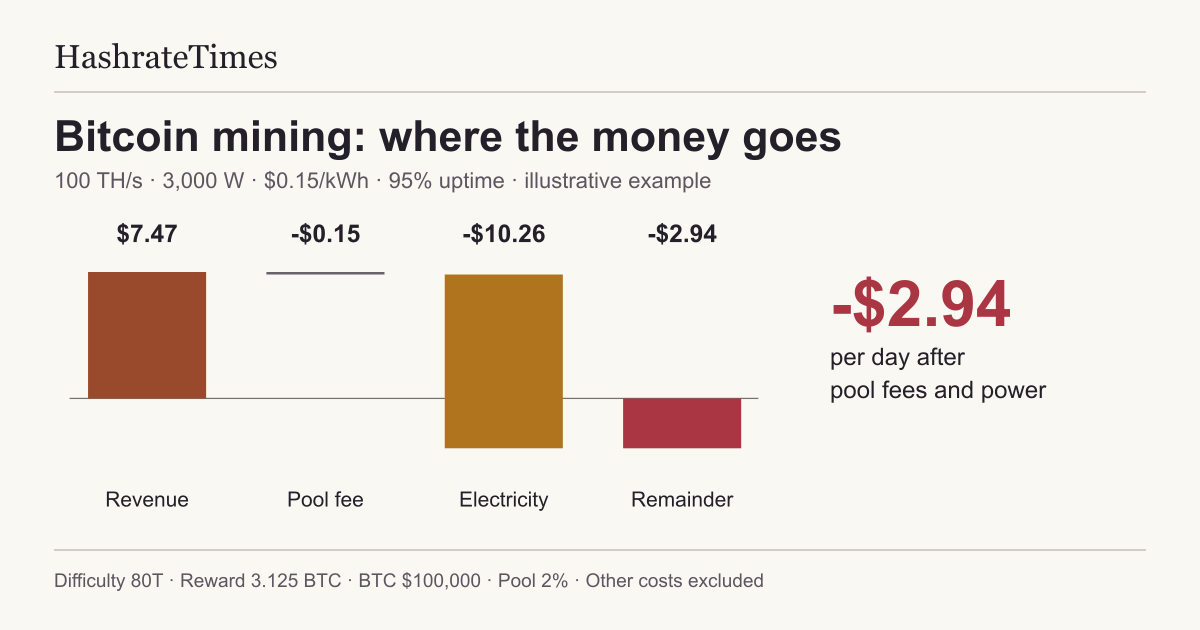
Start with measured or clearly labelled assumed hashrate, wall power, your electricity tariff, pool fee, and uptime. Add a dated BTC price, network difficulty, and an explicit reward assumption. The mining calculator lets you change those inputs; its starting values are an example, not a live equipment quote.
For scale, a hypothetical 3,000-watt machine running continuously uses 72 kWh per day. At $0.15/kWh, that is $10.80 of daily electricity before extra cooling or other costs. The energy-cost guide works through reduced uptime and changing tariffs.
Then reduce revenue and increase costs to see what stops working. Hardware purchase, repairs, hosting, financing, and taxes need a separate budget. A positive operating estimate is one input to that budget; the profitability guide shows how to interpret it.
Frequently asked questions
What does a Bitcoin mining machine do?
It repeatedly hashes candidate block headers and looks for a result at or below the network target. Full nodes still check all block and transaction rules before accepting a block.
Does a ten-minute block target mean my miner earns every ten minutes?
No. Ten minutes is a network average target, not a schedule for any block or any one miner. A small miner's solo block discoveries can be extremely irregular.
What should a first mining cost estimate include?
Use hashrate, measured wall power, electricity tariff, uptime, pool fee, a dated BTC price, current difficulty and a stated reward assumption. Budget hardware, cooling, repairs and other fixed costs separately.
Will joining a mining pool guarantee profit?
No. A pool can smooth the timing of credited rewards, but its fees and payout rules still apply. Electricity and equipment costs can exceed the bitcoin received.
Put it to work
Mining calculatorSources are listed above. This guide explains the mechanics; it is educational information, not a recommendation to invest or buy mining equipment.