In this field note
Electricity is a recurring mining expense that you can estimate before a machine arrives. The essentials are its power draw, the hours it operates, and the tariff that applies to those hours. Network-wide energy headlines cannot supply any of those inputs for your own setup.
This guide uses hypothetical equipment and prices to show the calculation. Its dollar amounts are examples, not electricity offers or a forecast of mining income.
Turn watts into a bill
Watts measure power: the rate of energy use. Kilowatt-hours measure energy consumed over time. Divide watts by 1,000, multiply by running hours, then multiply by the cost per kWh. The U.S. Energy Information Administration explains these units.
For a constant 3,000-watt draw:
| Operating period | Energy consumed | Cost at $0.15/kWh |
|---|---|---|
| One hour | 3 kWh | $0.45 |
| One full day | 72 kWh | $10.80 |
| Thirty full days | 2,160 kWh | $324.00 |
The monthly row uses exactly thirty days at full operation. It excludes separate cooling, fixed charges, and downtime. Writing those assumptions next to the number makes it possible to compare the estimate with a later bill.
Use the right measurement boundary
The useful power figure is the electricity required by the setup you are budgeting. A manufacturer’s wall-power specification may already include the power supply and built-in fans. Do not add those components twice. A board-only figure needs a different allowance.
List any equipment outside that measurement: ventilation, pumps, room cooling, and network equipment dedicated to the operation. For example, a separate 300-watt ventilation load running all day adds 7.2 kWh, or $1.08 at the example tariff. It raises total daily energy from 72 to 79.2 kWh.
Record the operating mode and conditions alongside the measurement. A power reading while a miner is starting, sleeping, or throttling should not become the assumed full-load figure. Our hardware comparison guide explains how to keep power and hashrate measurements comparable.
Uptime reduces work and may reduce consumption
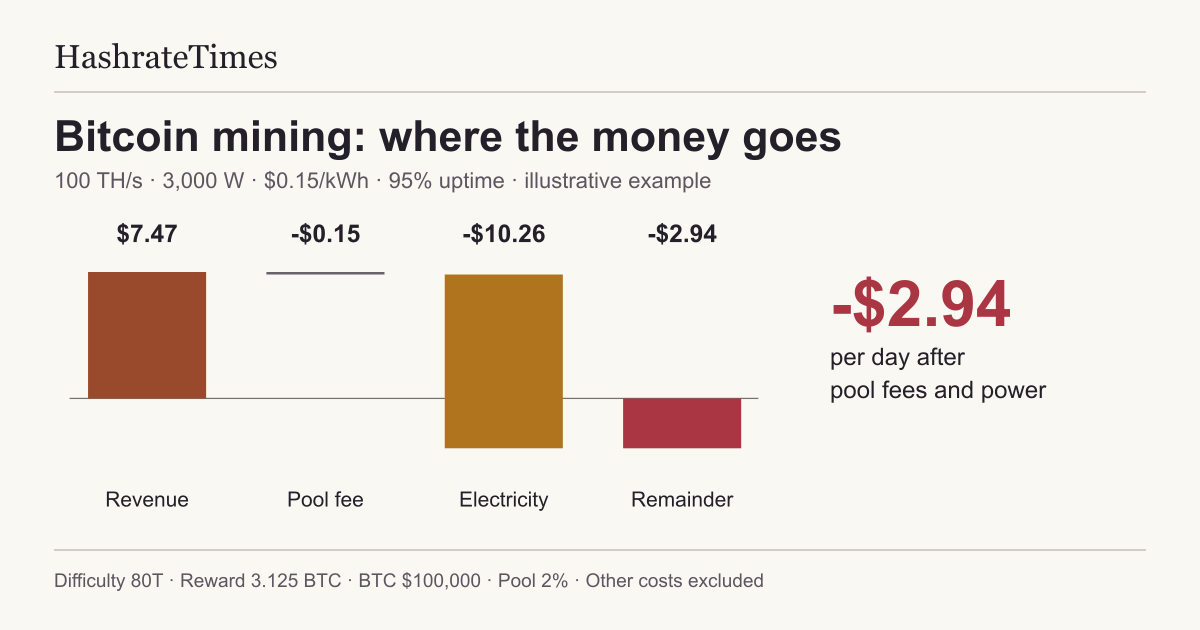
At 95% uptime, a simple on/off model gives the 3,000-watt machine 22.8 running hours daily. Energy becomes 68.4 kWh and electricity costs $10.26. Expected mining output also falls to 95% of its full-operation value, assuming unchanged performance while running.
That is the model used by our mining calculator: its uptime input scales both mining work and machine energy. It assumes the modelled machine uses no power during the remaining time.
Real downtime can differ. An internet outage might stop useful submissions while fans and hashing boards still consume electricity. A sleeping controller or ventilation system may remain powered. Add those measured loads separately instead of reducing the entire site’s bill by the uptime percentage.
For a partly curtailed machine, use separate operating periods with their own power and hashrate. A single average percentage cannot describe every combination of full output, reduced output, and idle power.
Match the tariff to the operating schedule
Electricity prices can change by customer class, location, season, and time of day. The EIA’s explanation of electricity pricing describes these differences. A national average is useful context but is not the price on your contract.
Suppose a machine runs twelve hours at $0.10/kWh and twelve at $0.20/kWh. At 3 kW, the daily bill is $3.60 plus $7.20, or $10.80. If it runs only during the cheaper twelve hours, electricity falls to $3.60, but its expected daily mining work also halves.
Keep fixed monthly charges and any demand charges separate from the energy rate. Ask which costs are additional because of mining and which would exist anyway. A hosting quote also needs a clear statement about cooling, maintenance, curtailment, and fees; an advertised kWh price alone is incomplete.
Find the electricity threshold
The electricity break-even price divides expected revenue after pool fees by daily energy. If a hypothetical scenario leaves $12 after the pool fee and uses 72 kWh, the threshold is about $0.1667/kWh. Above that rate, electricity alone exceeds the modelled proceeds.
With the separate 300-watt ventilation load, the same $12 must cover 79.2 kWh. The threshold falls to about $0.1515/kWh. Hardware and other expenses lower the rate a complete business budget can sustain further. The profitability guide connects this operating threshold with the rest of the budget.
Energy use and environmental impact answer different questions
A machine’s electricity bill does not by itself establish its emissions. That requires evidence about the electricity supply as well as consumption. Renewable generation can support mining, but an operation that depends on variable wind or solar also needs a model for storage, backup power, or reduced running hours.
Cambridge’s Bitcoin electricity methodology estimates network demand using hardware and economic assumptions, including a range around its central estimate. An annualised figure extends an estimated current rate across a year; it is different from measured consumption for a completed year.
Dividing network energy by transaction count does not measure the extra electricity caused by one more payment. Miners repeatedly hash block headers, and can continue that work without new transactions. This follows from the mining process, so a per-transaction ratio should not be used to size your machine or explain its bill.
Frequently asked questions
How do I convert miner power into a daily bill?
Divide measured watts by 1,000 to get kilowatts, multiply by operating hours, then by your price per kWh. Add separately measured cooling and other equipment loads.
Does 95% mining uptime always mean 95% electricity use?
Only in a simple on/off model where the miner uses no power while down. A powered but disconnected or idle setup can still consume electricity.
What does an electricity break-even rate leave out?
It compares revenue after pool fees with modelled energy only. Hardware purchase, repairs, hosting, cooling, financing, taxes and other charges can make the full operation unprofitable below that rate.
Can I use a national average electricity price?
Use it only as background context. A real budget needs the tariff that applies to your location, customer class and operating hours, plus fixed or demand charges where relevant.
Put it to work
Mining calculatorSources are listed above. This guide explains the mechanics; it is educational information, not a recommendation to invest or buy mining equipment.