In this field note
This Coinbase vs Kraken fees comparison follows one purchase from a US bank account to a personal Bitcoin wallet. The useful endpoint is the BTC received and total cash paid. A low trading percentage answers only part of that question.
The figures below come from public fee documents checked on 2 October 2026, plus labelled arithmetic examples. We did not place trades, obtain personal account quotes or time withdrawals. Links to Coinbase and Kraken on this page carry no HashrateTimes referral commission.
The US case we are comparing
The reader is an eligible, verified US resident with a supported US bank account. We chose the US because this example uses USD and ACH funding. It is an editorial scope choice, not a claim about where HashrateTimes readers live.
Use an ACH cash deposit, buy BTC/USD after funding, then withdraw on the Bitcoin base chain once holds clear. Assume no subscription, promotion, previous qualifying trading volume or asset balance that earns a better tier. Cards, instant bank-funded purchases, leverage, Lightning and wrapped BTC use different cost paths and are outside this example.
Kraken’s US domestic funding requirements exclude Texas, New York and Maine from its listed Plaid ACH route. This comparison therefore excludes those states. Eligibility and the funding methods actually offered in your account come first.
$500 means the BTC order value before trading fees. Fees paid in USD increase the cash required; fees deducted in BTC reduce the wallet receipt. A strict $500 cash budget needs a smaller order.
Simple buying and order books have different fees
| Purchase interface | Trading charge on $500 | What remains to check |
|---|---|---|
| Coinbase simple buy | Account-specific preview | Quoted price includes a spread; check the full debit and BTC amount. |
| Kraken Instant Buy | Published 1% = $5, before other costs | Spread and any payment charge, plus withdrawal. |
| Coinbase Advanced | $500 × your displayed maker/taker rate | Account tier, actual fill price and withdrawal. |
| Kraken Pro, entry tier | Maker 0.40% = $2; taker 0.80% = $4 | Actual fill price and withdrawal. |
Kraken’s fee schedule separates Instant Buy from Pro spot trading. The Pro figures match its July 2026 tier-change notice. They apply to the assumed entry tier, not every account. The 1% Instant Buy charge is not an all-in cost.
For Coinbase, use its Advanced fee guidance: current rates require sign-in and appear before the order. We do not substitute a Coinbase Exchange institutional table or an old Coinbase Pro rate for that quote.
Coinbase’s pricing disclosure describes an included spread for simple buys and no added spread for Advanced. An order book still has a bid/ask difference and possible slippage. Compare BTC received at the actual execution price, not just the percentage fee.
A maker order adds liquidity by resting on the book. A taker order fills against available orders. A limit price alone does not make an order a maker; immediate execution can incur a taker fee. Waiting for a maker fill also means the purchase may not happen.
Funding costs and the wait to withdraw
Kraken documents ACH cash deposits through Plaid with no processing fee and a seven-day withdrawal hold. That free deposit is a different step from an instant purchase directly funded by a payment method.
Coinbase lists ACH for US customers in its payment-method guide. Confirm the cash-deposit fee shown for your account; the public general disclosure does not give us a universal retail deposit quote. Its available-balance guidance also allows holds on deposited funds. Being able to buy is not the same as being able to send BTC out.
Check any bank-side charge separately. The worked example below assumes $0 funding cost on both sides and cleared holds. The Coinbase funding figure is an assumption, not a verified account offer. A BTC price can move during a hold; that changes the eventual dollar value of the coins.
A complete purchase-and-withdrawal example
To make the arithmetic reproducible, assume both orders fill at $100,000 per BTC. This is not a live price. A $500 order then buys 0.005 BTC before withdrawal.
For this calculation only, assume a 0.60% Coinbase Advanced taker rate and a 0.00002 BTC withdrawal charge on each exchange. Neither assumed withdrawal charge nor the Coinbase rate is a current account quote. Kraken’s 0.80% trading rate is the published entry-tier rate above. Trading fees are paid separately in USD; withdrawal fees are deducted from the BTC being sent.
| Worked item | Coinbase Advanced: assumed quote | Kraken Pro: published taker rate + assumed withdrawal |
|---|---|---|
| BTC order value | $500.00 | $500.00 |
| Trading fee | $3.00 at assumed 0.60% | $4.00 at published 0.80% |
| Cash paid, including trading fee | $503.00 | $504.00 |
| BTC bought at assumed price | 0.00500000 BTC | 0.00500000 BTC |
| Assumed BTC withdrawal charge | 0.00002000 BTC = $2.00 | 0.00002000 BTC = $2.00 |
| BTC arriving in the wallet | 0.00498000 BTC | 0.00498000 BTC |
| Fee cost at the assumed price | $5.00 | $6.00 |
The fee totals are $3 + $2 and $4 + $2. The wallet receipt is worth $498 at the assumed price, so cash paid minus received value gives the same result. The $2 is already deducted from the BTC; do not deduct it again from the wallet receipt.
This example does not establish a cheaper exchange. If the assumed Coinbase withdrawal charge were $4 instead of $2, its example fee total would become $7. With Kraken still at $6, the order reverses. Different execution prices can change it again.
For a strict $500 cash budget with a separately charged percentage trading fee, divide the budget by 1 + the fee rate. At 0.80%, $500 ÷ 1.008 permits about $496.03 of BTC before a $3.97 trading fee. The later BTC withdrawal deduction still applies. Round the order down as needed and use the platform preview for its actual fee handling.
The withdrawal quote is not a miner-fee estimate
Coinbase estimates its network charge; batching can make the network fee it actually pays different. Kraken’s withdrawal policy also makes the final confirmation authoritative. We could not verify a current fixed BTC charge from its public page, so no historic BTC withdrawal number is presented as today’s rate.
Use the exchange’s quote for the Bitcoin network, its minimum withdrawal and the amount the receiving address will get. A Lightning invoice or a wrapped-BTC network is a different destination and cannot be substituted to make this comparison look cheaper.
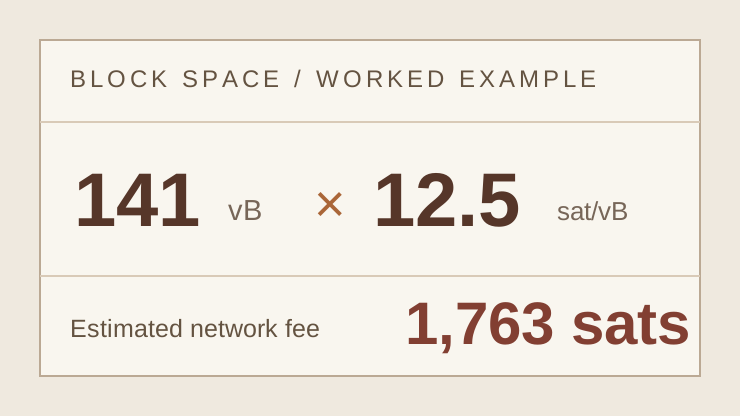
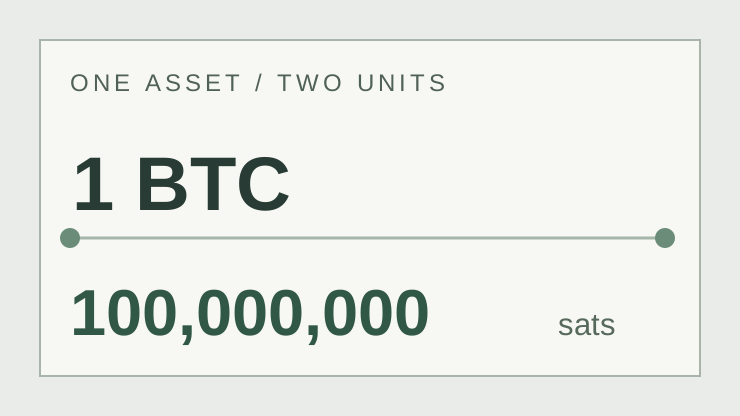
The Bitcoin fee calculator explains sat/vB × transaction size for a wallet transaction. It does not price an exchange withdrawal. The Satoshi converter can translate a quoted BTC charge into sats or USD using your chosen price. Read the Bitcoin fees field note for the network mechanics.
Compare your two previews
Use the same country, payment route, purchase interface and intended withdrawal network. Record each total cash debit, BTC credited, trading fee, quoted BTC withdrawal deduction and available-to-send date. Compare the previews close together so a moving BTC price does not masquerade as a fee difference.
For a fixed cash budget, compare BTC that will reach your wallet after all deductions. If the platforms show different cash debits, compare cash paid per BTC received instead. A smaller fee line does not necessarily buy more BTC.
Before sending, confirm that the receiving wallet supports the selected network and that you control its recovery method. The hardware and software wallet guide explains that custody choice. A separate test withdrawal can add a second fee and should be included in your own total.
Sources and method
The linked Coinbase help pages and Kraken fee/funding documents were read on 2 October 2026. Source claims, our calculation assumptions and unverified account-specific amounts are kept separate. This is a comparison of published rules and arithmetic, not a hands-on exchange review.
The ordinary source links on this page do not activate a referral relationship.
Frequently asked questions
Is Coinbase or Kraken cheaper for a $500 Bitcoin purchase?
The account quotes decide. Kraken Pro's published entry tier gives a $2 maker or $4 taker fee on $500 before fees. Add funding costs, execution-price differences and the BTC withdrawal charge. Coinbase Advanced requires your current account rate; this guide does not declare a universal winner.
Does a $500 buy mean I need only $500 in cash?
In this guide, $500 is the Bitcoin order value before trading fees. A $4 trading fee makes the cash debit $504 when charged in USD. A withdrawal fee deducted in BTC reduces what reaches your wallet. For a strict $500 budget, reduce the order size to leave room for fees.
Will a limit order always get the maker fee?
No. A limit order that fills immediately can be a taker order. An order that rests on the book can receive the maker rate when filled. A post-only order can prevent taking liquidity, but it does not guarantee a fill or a better final price.
Can the Bitcoin fee calculator predict my exchange withdrawal fee?
No. It estimates a transaction's network fee from sat/vB and virtual size. Coinbase or Kraken sets the charge shown in its own withdrawal preview. Do not add a separate estimated miner fee when the exchange quote already covers sending the BTC.
Can I withdraw immediately after an ACH deposit?
Not necessarily. Kraken's ACH Plaid cash deposit has a seven-day withdrawal hold. Coinbase can hold deposited funds, with timing shown for the account. Trading availability is different from permission to send BTC to an external wallet.
Sources are listed above. This comparison explains costs using published rules and labelled assumptions; it is educational information, not a recommendation to buy Bitcoin or use an exchange.