In this field note
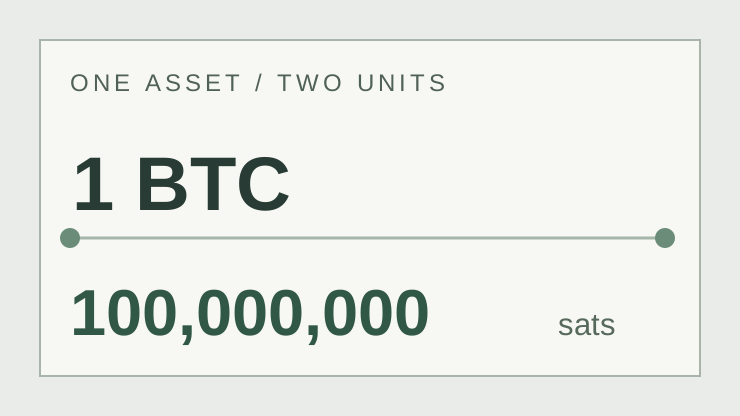
One bitcoin equals 100,000,000 satoshis. BTC and sats describe the same asset at different scales, much as dollars and cents describe different units of one currency. Writing a small bitcoin amount in sats can make it easier to read and compare.
The Bitcoin vocabulary defines a satoshi as the smallest bitcoin unit recorded on the blockchain. The conversion is fixed; the dollar value of either unit changes with Bitcoin’s market price.
Convert BTC and sats exactly
Multiply BTC by 100,000,000 to obtain sats. Divide sats by 100,000,000 to obtain BTC. The Bitcoin Core amount definition records this relationship directly.
| Bitcoin amount | Satoshi amount |
|---|---|
| 0.00000001 BTC | 1 sat |
| 0.00001 BTC | 1,000 sats |
| 0.00025 BTC | 25,000 sats |
| 0.001 BTC | 100,000 sats |
| 0.01 BTC | 1,000,000 sats |
| 1 BTC | 100,000,000 sats |
For example, 0.0025 BTC × 100,000,000 equals 250,000 sats. Converting back gives the same 0.0025 BTC. Neither direction requires a market price or creates a profit or loss.
Our satoshi converter performs these conversions and adds a dollar comparison using the BTC price you enter. Its example price is not a live quote.
Dollar conversion needs a price assumption
Suppose Bitcoin is valued at an illustrative $100,000 per BTC. Then 25,000 sats equals 0.00025 BTC, worth $25 at that price. At an illustrative $80,000/BTC, the same 25,000 sats is worth $20.
The sats balance did not change. Only the exchange assumption changed. Bitcoin.org’s introductory guidance explains that Bitcoin’s price can move unpredictably.
For dollars to sats, divide the dollar amount by the BTC price, then multiply by 100,000,000. Under the $100,000 example, $10 converts to 10,000 sats. Keep the price source and observation time alongside a conversion you intend to reuse. A real purchase or sale may also include a spread or service fee that this calculation does not model.
Understand precision and rounding
An on-chain amount must use whole satoshis, equivalent to no more than eight decimal places in BTC. For an on-chain amount, enter whole sats or BTC at that precision. A display with additional decimal places does not establish that a fractional satoshi can be sent on-chain.
Dollar conversions often land between whole sats. At an assumed $60,000/BTC, $1 converts mathematically to about 1,666.6667 sats. The HashrateTimes converter rounds a dollar input to the nearest whole satoshi, producing 1,667 sats, or 0.00001667 BTC.
This is an arithmetic estimate rather than a transaction instruction. It does not check a wallet’s minimum send amount, service withdrawal rules, or transaction fee. A very small amount can be valid as a unit conversion yet impractical to transfer by itself.
A fee rate is different from a balance
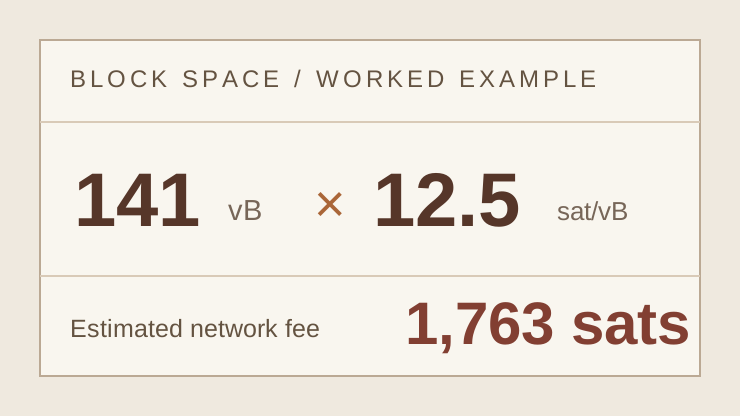
The number 20 sats is an amount. The number 20 sat/vB is a rate: twenty satoshis per virtual byte of transaction space. Multiplying that illustrative rate by a 140-vB transaction gives a total fee of 2,800 sats.
Use the Bitcoin fee calculator when you have a rate and size, and read how Bitcoin fees work to understand why two payments can need different fees. The transaction guide explains the inputs and outputs behind a payment.
Check the label before copying an amount
Keep the unit visible when moving values between a wallet, a spreadsheet, and a calculator. Entering 25,000 in a BTC field has a very different meaning from entering it in a sats field. Check decimal and thousands separators too; the examples here use a decimal point and commas to group thousands.
A token name or ticker containing “satoshi” does not make it a Bitcoin unit. Establish the asset and network first. Once those match, checking the same amount in both BTC and sats is a useful way to catch misplaced decimal points before confirming a payment.
Frequently asked questions
How many satoshis are in one bitcoin?
One BTC contains exactly 100,000,000 satoshis. Multiply BTC by that number to get sats, or divide sats by it to get BTC.
Is a satoshi another cryptocurrency?
No. It is Bitcoin's smallest on-chain unit. A separate token with a similar name should not be treated as the BTC unit without checking its asset and network.
Can an on-chain payment contain a fraction of a satoshi?
No. On-chain Bitcoin amounts use whole satoshis. A dollar conversion may produce a fractional mathematical result, so the converter rounds to the nearest whole satoshi.
Why does the same sats balance show a different dollar value later?
The number of sats is unchanged, but a different BTC price changes the dollar comparison. The converter's price is an explicit input, not an automatically refreshed quote.
Put it to work
Satoshi converterSources are listed above. This guide explains the mechanics; it is educational information, not a recommendation to invest or buy mining equipment.