In this field note
Put the two clocks side by side
A miner estimates its speed locally. A pool sees the shares that arrive and meet its requirements. The unit on both screens may say TH/s while the two numbers describe different observations. Braiins explains how it derives effective hashrate. Shares arrive unevenly even when the machine runs steadily.
Write down the worker name, unit, start and end of the interval on each screen. A five-minute local reading beside a 24-hour pool estimate is a poor test of a fault that began ten minutes ago. A farm total beside one worker is worse. If the units differ, put both readings through the hashrate converter first.
What one low hour tells you
Suppose a worker runs near 100 TH/s. The pool reports the following illustrative hourly estimates. Each hour is separate and equally long.
| Hour | Pool estimate |
|---|---|
| First | 100 TH/s |
| Second | 80 TH/s |
| Third | 120 TH/s |
| Fourth | 100 TH/s |
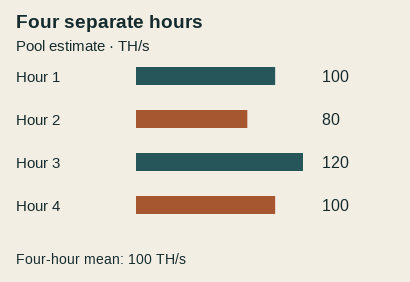
Their mean is 100 TH/s. Looking only at hour two would suggest a 20% shortfall. Looking only at hour three would suggest a 20% improvement. Neither describes the whole run. If an hour is missing, leave it marked unknown. Filling it with zero quietly turns a gap in the record into an outage.
When the gap deserves a closer look
If the longer pool average stays low, line up the miner log and pool record. Do reconnects cluster in the missing periods? Did work move to a backup pool? Do rejected shares rise while the local reading stays steady? Those observations give you different things to investigate. With variable share difficulty, counting raw submissions alone can misstate the amount of work.
If both readings fall together, look at the device status and uptime. If only one pool window dips and the gap closes over the next comparable windows, keep the record as a baseline. The pool’s explanation of share variance gives the reason a short sample can move either way. See the pool guide for how accepted work feeds into rewards.
Frequently asked questions
Can the pool report more than the machine?
Yes. A worker can find more valid shares than expected over a short interval. A high point needs the same time-window check as a dip.
Can I average the four values on my dashboard?
Only if they are averages for the same worker over four separate, equally long intervals with the same weighting. Overlapping rolling averages count some of the same work several times.
Which reading should I keep for a support request?
Save both screens with the worker name, units, timestamps and averaging windows. Include the relevant reconnect or rejection log if there is one.
Put it to work
Open calculatorSources are listed above. This guide explains the mechanics; it is educational information, not a recommendation to invest or buy mining equipment.