In this field note
A mining pool coordinates work from multiple miners and accounts for each participant’s contribution. Its main practical benefit is a payment pattern that can be less erratic than waiting for a solo block. The network difficulty stays the same, and the electricity bill still needs paying.
To understand a pool offer, follow the whole sequence: useful work is submitted, a reward is calculated, a balance is credited, and a payout eventually reaches a wallet. The rules for each stage matter as much as the advertised fee.
A share is evidence of work
A pool asks miners to submit hashes that meet its share target, which is normally easier than Bitcoin’s block target. Most accepted shares qualify only for pool accounting; a rare qualifying result also meets the network target. The Bitcoin developer mining guide describes this relationship.
Share difficulty can differ between workers. Ten thousand easy shares should not automatically be counted as more work than fewer difficult shares. Operators weight submitted work according to their accounting rules. The Braiins pool FAQ explains share difficulty and why short-term share counts fluctuate.
This is why the hashrate on a machine’s dashboard can differ from the pool’s estimate. One describes device performance; the other infers work from submissions over a time window. Compare matching periods and inspect rejected or stale shares before concluding that a device is underperforming. Keep measured power in the comparison too, as explained in our hardware guide.
Payment methods distribute risk differently
The main labels describe how a pool turns shares into rewards. The exact contract and calculation still need checking.
| Method | Basic accounting approach | What to examine |
|---|---|---|
| PPS, pay per share | Pays an expected subsidy-based value for eligible work | The rate calculation and treatment of transaction fees |
| FPPS, full pay per share | Adds an expected transaction-fee component to PPS | How the fee average is measured and updated |
| PPLNS, pay per last N shares | Distributes actual block proceeds over a defined share window | Window rules, block luck, and payment lag |
| PPS+ | Combines PPS subsidy accounting with block-linked fee distribution | How the two components are combined |
These descriptions follow f2pool’s explanation of payout schemes. They describe mechanisms rather than recommending a pool.
With an FPPS-style method, the operator absorbs the direct effect of its own short-term block luck. Your earnings still change with submitted work and the rate calculation. Braiins, for example, documents a daily FPPS calculation that includes a daily average of transaction fees in its rewards FAQ. That does not promise a fixed dollar income or remove the risk that an operator fails to pay.
Understand the fee’s calculation basis
Suppose a pool calculation assigns you 0.00020 BTC before a hypothetical 2% pool fee. That fee is 0.000004 BTC, leaving 0.000196 BTC before any other deductions. At an assumed $100,000/BTC, those amounts are $20.00, $0.40, and $19.60 respectively.
The example says nothing about electricity or hardware costs. It also assumes the entire quoted amount is subject to the same percentage. A pool that treats transaction-fee revenue separately may require a different calculation.
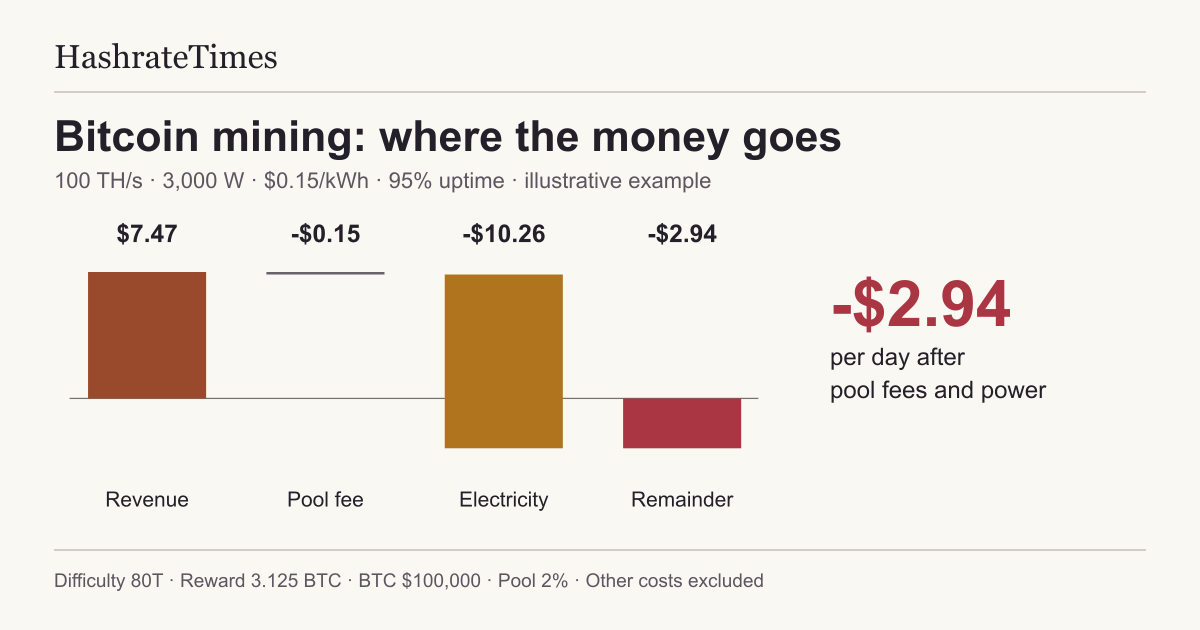
Our mining calculator deducts a single percentage from modelled gross revenue. Use it to compare that cost, then add withdrawal charges or other contract terms separately. The profitability guide shows how pool fees fit into an operating budget.
A credited balance can wait for withdrawal
Assume a hypothetical 0.001 BTC withdrawal threshold and credits averaging 0.00005 BTC per day after the pool fee. Starting from zero, reaching the threshold would take about twenty days if that average held. A daily payout schedule does not mean this miner receives bitcoin every day.
Check the minimum, the schedule, the payout network, and any withdrawal fee. On-chain transfers also need confirmation after a pool broadcasts them. Lightning payouts have their own receiving requirements and limits. As one concrete documentation example, Braiins publishes payout rules, fees, and thresholds separately. Verify an operator’s current terms when using them; this guide does not freeze those terms into a comparison table.
Connection quality and account control matter
Before relying on a pool, record whether the intended coin and algorithm are supported, the correct connection endpoint, the worker naming rules, and how failed connections are handled. A pool supporting one proof-of-work coin does not thereby support every mining device.
Monitor accepted work over a meaningful period. Persistent rejection or disconnects deserve investigation because electricity can be consumed without credited work. A backup pool configuration may help continuity, but its payout rules and wallet destination also need checking.
Use the operator’s available account protections and verify payout addresses carefully. An unpaid balance depends on the pool’s accounting, solvency, and security. A pool does not need your wallet recovery phrase to send a payout; read protecting private keys before confusing account access with control of a wallet.
Switching pools and concentration
Changing a connection endpoint can redirect future hashpower, but it does not automatically move an old balance. Check the old pool’s threshold and any remaining PPLNS window first, and save your accounting records.
Pool concentration also matters because operators can coordinate substantial mining work. An observed pool share does not by itself prove that one owner controls all connected equipment, and rankings change. Compare the operational terms you can verify instead of selecting purely from a size ranking. The right comparison keeps hardware and network assumptions fixed while examining payment rules, realized submissions, and access to your proceeds.
Frequently asked questions
Does joining a pool reduce Bitcoin network difficulty?
No. The network target applies to every candidate block. A pool coordinates work and distributes rewards under its own terms; it does not make the network target easier.
What is the difference between a share and a payout?
A share records work submitted to the pool under its share target. The operator then credits rewards according to its method; a separate threshold and schedule govern when bitcoin reaches your wallet.
Are PPS and PPLNS payments the same?
No. PPS pays an expected value for eligible shares, while PPLNS distributes proceeds across a defined recent share window. Check each operator's actual fee, fee-revenue treatment and payout terms.
Does a daily payout schedule mean I receive bitcoin every day?
Not necessarily. A balance may remain in the pool account until it reaches the operator's minimum, and transfers can depend on the selected network and payout rules.
Put it to work
Mining calculatorSources are listed above. This guide explains the mechanics; it is educational information, not a recommendation to invest or buy mining equipment.