In this field note
A mining machine needs to fit both a calculation and a physical place. Its hashrate determines how much work it can attempt; its power draw determines much of its operating cost. Noise, cooling, electrical requirements, support, and purchase terms determine whether the proposed operation is practical.
A useful comparison therefore starts with the exact model and operating mode, then puts each candidate through the same assumptions. This guide uses hypothetical machines for arithmetic and one manufacturer’s manual to show what a real specification includes. It does not rank products or recommend a purchase.
Start with the algorithm
Bitcoin proof-of-work mining uses SHA-256-based hashing. An ASIC is an application-specific integrated circuit: hardware built for a particular task. Commercial Bitcoin mining uses specialized equipment, as described in the Bitcoin FAQ. A device designed for another mining algorithm cannot be compared with a Bitcoin ASIC simply because it reports a large number of hashes per second.
General-purpose CPUs and GPUs can run different software, but that flexibility does not establish competitive Bitcoin mining economics. Switching an ASIC between coins requires compatible hashing and support in the device software and chosen pool. Changing a coin name in a calculator is not enough to establish compatibility.
Keep the algorithm, supported coins, firmware version, and intended pool in the equipment record. The mining pool guide covers the connection and payment side of that record.
Read hashrate together with wall power
Hashrate is measured in hashes per second; Bitcoin ASIC specifications commonly use TH/s, or trillions of hashes per second. Electrical power is measured in watts. Dividing watts by TH/s gives joules per terahash, often written J/TH. Lower J/TH means less energy for the same hashing work under comparable conditions.
Consider two hypothetical devices:
| Specification | Machine A | Machine B |
|---|---|---|
| Hashrate | 100 TH/s | 150 TH/s |
| Wall power | 3,000 W | 3,000 W |
| Efficiency | 30 J/TH | 20 J/TH |
| Daily energy at full operation | 72 kWh | 72 kWh |
Machine B attempts 50% more work for the same modelled electricity use. At unchanged difficulty and uptime, its expected mining output is 50% higher. That observation does not compare purchase prices, service life, or repair costs.
Now imagine Machine C produces 150 TH/s at 4,500 W. Its efficiency is 30 J/TH: the same as Machine A. It produces more work by drawing proportionally more power. A larger hashrate number can therefore describe either better efficiency or simply a larger electrical load.
Check the conditions behind the specification
The exact product version matters. For example, BITMAIN’s S21 user guide lists a 200 TH/s version at 3,500 watts and 17.5 J/TH, with wall measurements at a specified inlet temperature. It also gives tolerances, electrical requirements, environmental limits, and a noise measurement condition. These are documentation examples, not independently measured performance or a claim about the best current model.
For each candidate, record whether power is measured at the wall or only at the hashing boards. Establish whether the power supply and fans are already included. Check whether the quoted number refers to normal operation, a low-power setting, or an altered performance mode.
More aggressive settings can change both watts and hashrate. Use both measurements from the same mode. Do not combine the fastest advertised hashrate with a power figure taken from a lower-output setting.
Decide whether the site can support it
Equipment manuals are the starting point for voltage, connectors, environmental conditions, and ventilation requirements. A plug that appears to fit is insufficient evidence that an existing circuit can support continuous operation. Have a qualified electrician assess the intended supply against the actual equipment requirements.
Plan where heat and noise will go, including during warm weather. Separate room cooling, extraction fans, or liquid-cooling equipment can add capital cost and electricity beyond the miner’s own wall draw. The energy-cost guide shows how to include those loads without counting the same power twice.
Make the operating assumption concrete: a machine that must be switched off every night because of noise cannot be modelled at full daily uptime. Likewise, a reliable internet connection and accessible maintenance space belong in the plan rather than appearing as surprises after delivery.
Compare the installed cost and evidence
Use an itemized purchase record covering the exact model, condition, power supply, cables, shipping, applicable import costs, installation, and any separate cooling. Record delivery expectations and the seller’s repair or return terms. A dated equipment quote should stay separate from hypothetical BTC revenue.
For used equipment, seek evidence that matches the actual unit: identifiers, operating history where available, sustained hashrate, error reports, and power measurements under stated conditions. A single dashboard screenshot is limited evidence of stability or the condition of every board.
Physical life and economic life are different. A functioning miner can become too costly to run under a particular tariff, while another site may still be able to use it. Budget repair and resale assumptions explicitly instead of assigning every ASIC the same replacement date.
Run a fair operating comparison
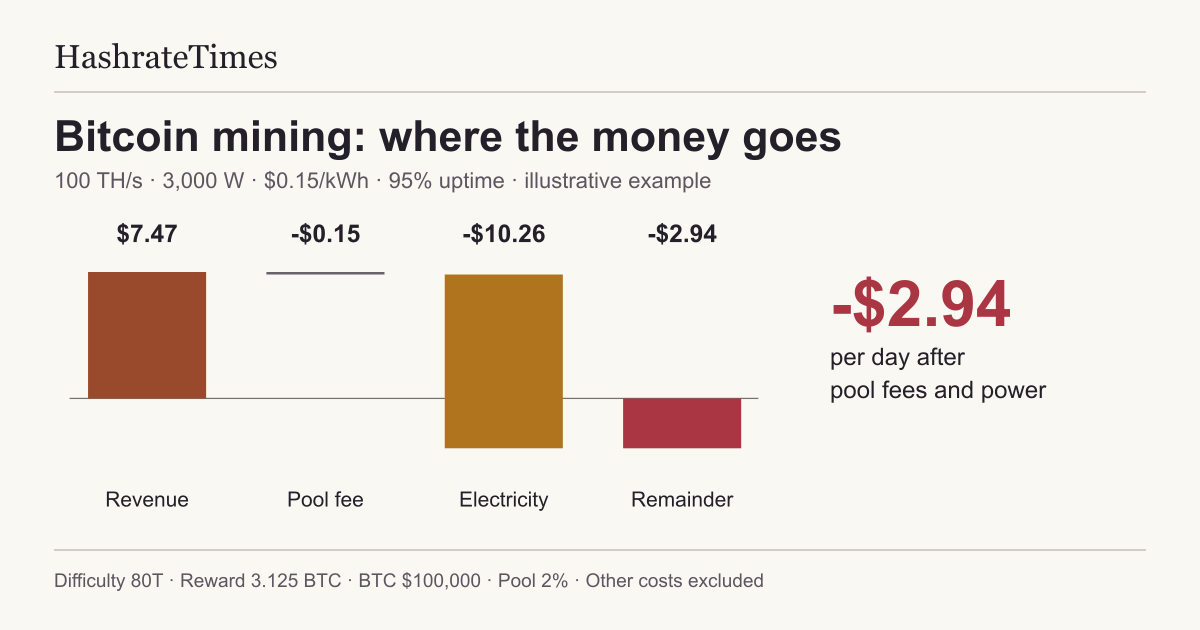
Open the mining calculator and hold BTC price, difficulty, reward, pool fee, uptime, and electricity price constant. Change only hashrate and power for each device. Note the operating remainder and electricity threshold, then repeat with a higher tariff or lower revenue assumption.
The calculator excludes the purchase and site costs described here. Combine its output with those costs using the profitability guide. The result should show what evidence supports each input and which unknowns could reverse the comparison.
Frequently asked questions
What does J/TH tell me about a miner?
Joules per terahash equals watts divided by TH/s. A lower value means less electricity for the same hashing work when measurements use comparable operating conditions.
Can a high hashrate alone identify the better machine?
No. A larger hashrate can come with proportionally more wall power. Compare energy efficiency, purchase cost, reliability and the site needed to run the exact model.
Can I use an ASIC for another algorithm to mine Bitcoin?
Do not assume so. Check the machine's supported algorithm, firmware and pool compatibility before treating its reported hashes per second as Bitcoin hashrate.
Does the J/TH rating include site cooling?
Usually it describes the miner under stated test conditions, not the entire site. Check the specification's power measurement boundary and add separate ventilation or cooling loads to the budget.
Put it to work
Mining calculatorSources are listed above. This guide explains the mechanics; it is educational information, not a recommendation to invest or buy mining equipment.