100 W × 22.8 hours
2.28 kWh per day · assumed 95% uptime
In this field note
A small electricity bill can hide two larger questions: whether enough KAS is being credited, and when any of it reaches your wallet. This case separates those questions using a named device specification, published pool terms and deliberately hypothetical operating inputs. It is a budgeting exercise, not a hands-on review or a purchase recommendation.
Start with a device, not a revenue screenshot
ICERIVER lists the KS0 ULTRA at 400 GH/s and 100 W, each with a ±10% tolerance, and says the power supply is not included. Those are manufacturer claims, not measurements made by HashrateTimes.
The product page’s main specification uses watts; a detail row labels power as “W/h”. Our calculation uses 100 W of power, consistent with the main specification. Before budgeting a real setup, measure total wall draw with its actual power supply and cooling. Do not turn a typographical unit inconsistency into an energy formula.
The model below uses 95% uptime and no draw while switched off. It excludes auxiliary cooling, network equipment and fixed charges. The mining energy-cost guide explains how to include those loads without counting them twice.
| Input | Case value | What it means |
|---|---|---|
| Device specification | KS0 ULTRA, 400 GH/s, 100 W | Manufacturer reference; not a yield forecast |
| Daily operating time | 22.8 hours | Assumed 95% uptime |
| Electricity tariff | $0.15/kWh | Example rate, not an offer |
| KAS value | $0.10 per KAS | Assumption, not today’s market price |
| Pool fee | 1% | Published f2pool KAS example |
| Other costs | Not included | Hardware and operating extras remain unpaid |
Work backwards from the electricity bill
Daily energy is 100 ÷ 1,000 × 24 × 0.95 = 2.28 kWh. Multiplying by $0.15/kWh gives $0.342 per day, or $10.26 for exactly 30 identical days. Keep the unrounded daily number when comparing small credits.
If a pool fee is deducted from gross KAS, the electricity-only threshold is:
Required gross KAS/day = daily electricity cost ÷ [assumed USD/KAS × (1 − pool fee)].
Here that is 0.342 ÷ [0.10 × 0.99] = 3.454545… KAS/day. 3.46 KAS is rounded upward to two decimals. If your pool record already shows credit after its fee, compare that net credit with 3.42 KAS; do not deduct the fee twice.
| Assumed KAS value | Gross KAS/day needed for power |
|---|---|
| $0.05 | 6.91 |
| $0.10 | 3.46 |
| $0.20 | 1.73 |
These thresholds are rounded up and hold the power bill and 1% fee fixed. They are not expected production at 400 GH/s. Actual accepted work, network competition and reward conditions are missing from a device specification.
At the manufacturer’s ±10% power bounds, the same on/off model gives a daily electricity bill from $0.3078 to $0.3762. If the machine keeps drawing 100 W during an internet outage instead of switching off, a full day’s energy is 2.4 kWh and costs $0.36. Your meter determines which boundary applies.
A pool balance is not a wallet payment
The f2pool KAS help page, read on 18 September 2026, lists 1% PPLNS, thresholds of 100, 200 or 1,000 KAS, and a daily payment window of 00:00–08:00 UTC. Its help-article update is dated 13 November 2025; retrieval today does not make those terms newly announced.
The pool’s detailed Kaspa guide also states that distribution requires reaching the threshold. Check the settings and current terms for your own account. “Daily payouts” describes a processing schedule; it does not mean every small miner gets a transaction every day. A PPLNS label is not a fixed daily-return promise.
For arithmetic only, suppose a pool ledger credited five gross KAS per day, already reflecting your operating time. This number is invented to demonstrate the ledger; it is not an estimate for the KS0 ULTRA.
| Daily ledger item | Illustrative amount |
|---|---|
| Gross credit | 5 KAS |
| Pool deduction at 1% | 0.05 KAS |
| Credit after fee | 4.95 KAS |
| Value at assumed $0.10/KAS | $0.495 |
| Modelled electricity | −$0.342 |
| Remainder before other costs | +$0.153 |
Starting at zero, a 100 KAS threshold would require about 20.2 days of that constant net credit. Under once-daily settlement, it may first qualify around the 21st daily batch; exact timing, credits and eligibility can differ. Electricity bills can accrue throughout that wait. Neither an estimated credit nor its dollar valuation is money already received or sold.
Challenge the apparent surplus
With the hypothetical 4.95 net KAS/day and the same $0.10 valuation, a $0.05/kWh tariff leaves $0.381/day before other costs. At $0.30/kWh, the result becomes a $0.189/day loss. A small change in an assumption can dominate a small positive remainder.
The strongest case for this approach is that the electricity requirement is measurable and the threshold can be checked against a dated ledger. The strongest limitation is that the ledger can deteriorate while hardware costs remain. Buying a device also commits money to the machine, power supply and any installation, shipping or taxes; none is recovered by merely covering today’s electricity.
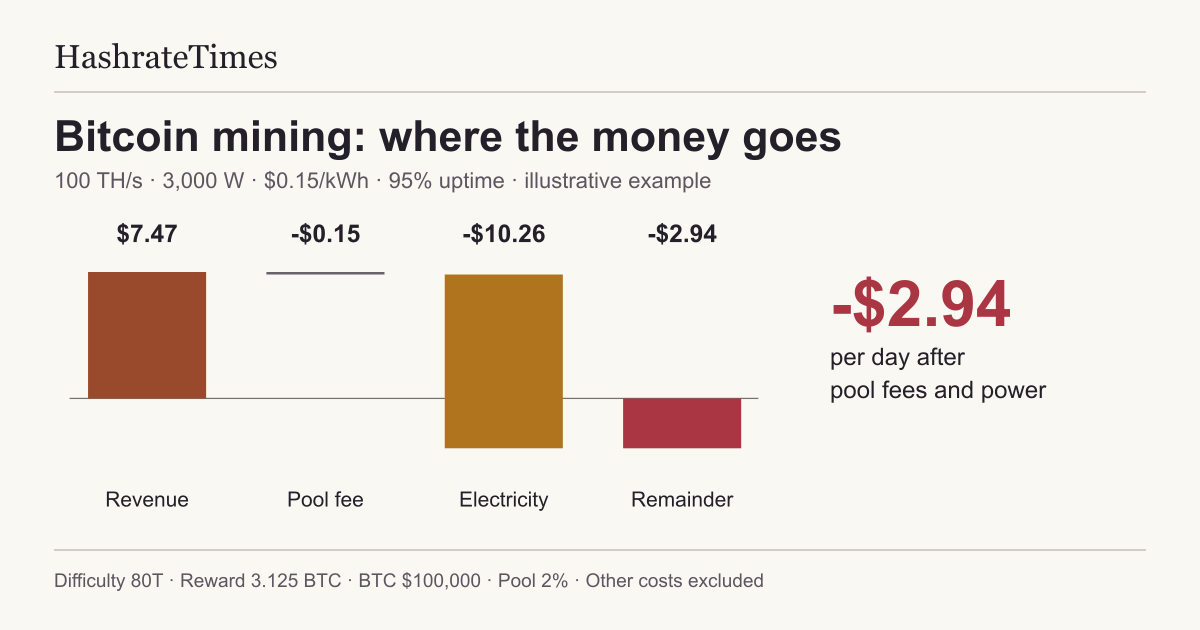
Kaspa’s mining work uses kHeavyHash, as described in the pool’s mining guide. Our Bitcoin profitability guide teaches the same separation of revenue and costs, but the Bitcoin calculator is not a Kaspa yield estimator.
More blocks must not be mistaken for proportionally more issuance. KIP 14’s reward specification adjusts reward per block when block rate changes to preserve the emission schedule. This article does not claim a current subsidy or forecast a year of mining receipts from one day’s result.
Keep a record that can prove the difference
For a matched, dated period, record wall-meter kWh, accepted pool work, gross or net KAS credit, all deductions, and actual wallet receipts. State the valuation time and currency separately. The pool guide explains why work submitted, credit and receipt belong in separate columns.
Recalculate when the tariff, measured power, credited output, fees or KAS valuation changes. A positive electricity-only remainder is a reason to complete the full cost ledger, not proof that the purchase pays for itself. If actual credits stay below the electricity-covering requirement, the chosen assumptions do not cover the modelled power bill.
Sources and arithmetic checked on 18 September 2026. No personal device test, current mining return, exchange quote or affiliate relationship is claimed.
Frequently asked questions
Is the KS0 ULTRA profitable at $0.15 per kWh?
The specification alone cannot answer that. At an assumed 100 W and 95% uptime, power costs $0.342/day. Compare that with dated pool credits after fees and an explicit KAS valuation, then include other costs.
How much KAS covers the electricity in this example?
At an assumed $0.10/KAS and 1% pool fee, $0.342 of power requires about 3.4545 gross KAS per day, or 3.46 rounded up to two decimals. This covers only the modelled electricity.
Does f2pool pay every Kaspa miner every day?
No. Its published KAS terms list 100, 200 or 1000 KAS thresholds and a daily 00:00–08:00 UTC payout window. A balance below the selected threshold is not a daily wallet payment.
Can I use the Bitcoin calculator for Kaspa?
No. The electricity arithmetic transfers, but the Bitcoin reward and difficulty model does not become a Kaspa yield model by changing the coin label. Use dated Kaspa pool records for this cost comparison.
Sources are listed above. This guide explains the mechanics; it is educational information, not a recommendation to invest or buy mining equipment.