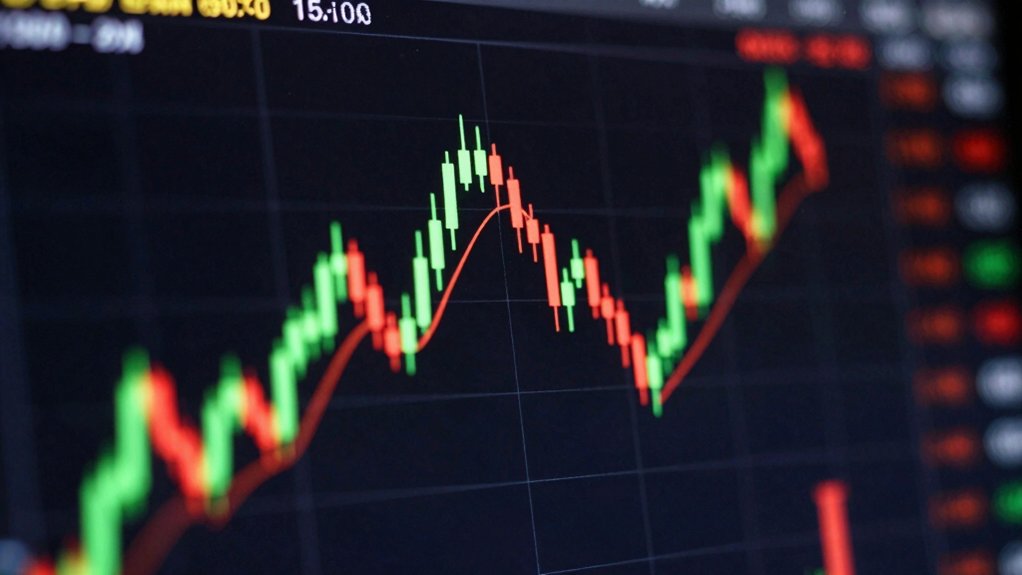

Observing parabolic moves—defined by a near-vertical ascent in asset prices that accelerates exponentially over days or weeks—has become increasingly common among short term traders, prompting questions about their sustainability. These price actions exhibit steep, curved trajectories resembling one side of a parabola, often resulting in gains between 50% and 200% within short timeframes. Unlike typical trends, parabolic moves feature minimal or shallow retracements and consistent one-sided candle prints, reflecting rapid momentum and heightened emotional participation, particularly driven by fear of missing out (FOMO). The shape of these moves closely resembles a parabola, hence their name. Traders should be aware that momentum oscillators like RSI can help identify the extremity of such moves.
Such moves are mathematically unsustainable due to their exponential acceleration, inevitably culminating in sharp corrections that can reverse at least 30% of the price gains. This dynamic suggests that parabolic moves represent the peak of emotional buying, frequently followed by significant downturns—some reaching declines as severe as 80%. The mechanisms behind these moves involve stair-stepping bases with intermittent pullbacks before the price escalates rapidly, a pattern seen in historic examples like Bitcoin’s surge from $10,000 to $20,000 over 17 days in late 2017, which was quickly succeeded by an extended crash over the subsequent year. Because the gains in this phase can be driven by extreme FOMO, leverage, and euphoria, traders should be cautious about entering at these peaks.
Parabolic moves, driven by peak emotional buying, are unsustainable and often lead to sharp corrections of 30% to 80%.
Identifying parabolic moves requires attention to technical signals, such as the parabolic SAR indicator marking vertical price angles, bearish divergences on volume-based indicators like OBV, and extreme readings on momentum oscillators such as RSI, which collectively suggest trend exhaustion. Additionally, reversal candlestick patterns, including shooting stars or engulfing formations, serve as additional warnings that the accelerated price rise may be nearing its end. Traders monitoring these signals gain essential insights to avoid chasing unsustainable price levels.
Despite the allure of rapid profits, parabolic moves carry significant risks, including heightened volatility, slippage, and the temptation for overleveraging, often resulting in abrupt losses for late entrants. Effective risk management strategies emphasize the importance of setting stop-loss orders, profit targets, and maintaining disciplined exit plans, supported by real-time data and volume confirmation, to navigate the uncertainties inherent in such extreme market behavior. Combining RSI with other indicators can improve decision-making in these volatile conditions.