In this field note
Imagine being paid for a piece of freelance work. The client needs to know that the payment reached you. They do not need a window into your other customers, savings or future spending. That is the everyday question behind financial privacy: how much information travels with a payment, and who can read it?
Bitcoin and Zcash answer that question differently at the blockchain level. This guide compares ordinary on-chain Bitcoin payments with Zcash’s transparent and shielded transfers. It does not compare every Bitcoin privacy tool or Lightning wallet, and it is not a hands-on wallet review.
What a Bitcoin payment makes public
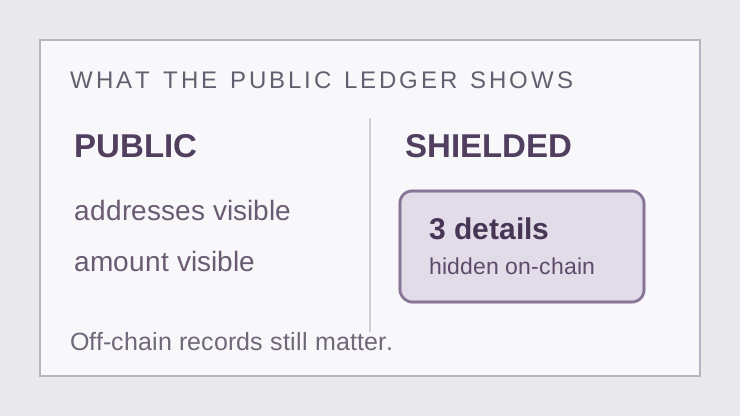
A Bitcoin address does not contain a person’s name. But the public ledger records transaction inputs, outputs and amounts. If someone links an address to an identity, that gives them a starting point for examining its activity. Reusing a receiving address makes that connection more persistent. Bitcoin.org’s privacy guidance explains both the transparency and the value of careful address use.
For our freelancer, publishing a payment address on a portfolio site can connect otherwise technical records to their business. This does not mean that every observer instantly knows all their holdings. It means the ledger supplies information that can be combined with information from elsewhere.
What shielding changes in Zcash
Zcash supports transparent transfers and shielded transfers. In a fully shielded transfer, the sender, recipient and transferred amount are not publicly disclosed in the same way as a transparent payment. The network can still validate the transaction. The Zcash explanation of shielding describes this choice.
That difference matters to someone who wants a payment to work without advertising its details to unrelated observers. It does not mean that all activity involving the ZEC asset is automatically private.
| Payment situation | What to understand |
|---|---|
| Ordinary on-chain Bitcoin payment | Transaction details are public; an address is a pseudonym, not guaranteed anonymity. |
| Transparent Zcash transfer | The transparent part exposes payment information on the public ledger. |
| Fully shielded Zcash transfer | The payment’s sensitive details are protected from public blockchain observers. |
| Transfer between transparent and shielded parts | The transparent side and amounts crossing the boundary can reveal information. |
How can the network check a hidden payment?
Zcash uses zero-knowledge proofs: cryptographic evidence that a statement is valid without publishing the underlying private information. A proof can establish that the transaction satisfies the required rules while keeping payment details concealed. It is not a request for validators to skip checking the transaction. See the project’s introduction to zero-knowledge proofs.
Think of two separate questions: “Does this payment obey the rules?” and “Must everyone see the private details to check it?” The purpose of the proof is to separate those questions. This analogy explains the goal; it is not a description of the cryptographic implementation.
Holding ZEC and using shielded payments
A balance on an exchange tells you that your account has an exposure to ZEC. It does not establish which transaction types the platform supports for withdrawals. A wallet listing ZEC among its supported assets also does not, on its own, prove shielded sending or receiving. The official Zcash usage guide distinguishes wallets that shield by default, offer a choice or support transparent transactions only.
Before choosing a route, check the sending service and receiving wallet together. Look for explicit support for the transaction type you intend to use, in the current application version. A generic “Zcash supported” badge leaves an important question unanswered.
A unified address is a routing tool
Unified addresses can package more than one type of receiver into a single address. The sender’s software must interpret it and select a supported payment method. The Unified Address specification describes that compatibility mechanism, including interaction with transparent-only software.
Therefore, seeing a unified address is not enough to establish the privacy of every possible transfer involving it. Check what the sending wallet will actually do. The specification also distinguishes active rules from draft revisions; a proposed feature is not proof that an installed wallet supports it.
Private from whom?
Shielding protects information from public blockchain observers. A payment recipient still knows about the payment they receive. An exchange can retain information about your account and your interaction with its service. A private blockchain transfer does not erase a receipt, a conversation or information you deliberately shared.
Viewing keys introduce another deliberate disclosure route. For example, Sapling viewing keys can allow a third party to inspect specified wallet activity without giving them spending authority; the exact scope matters. ZIP 310 documents those properties. Treat such access as sharing financial information, even though it is not permission to move funds.
A useful comparison before choosing a wallet
Keep three decisions separate: which asset you want to use, who controls its spending keys, and what the payment reveals. A hardware device may help protect keys while the transaction still exposes data. Conversely, a shielded transaction does not make a weak backup or an untrusted recipient safe.
For the freelancer, a useful checklist is practical: can the client use the intended route, what information will each party see, and can the recipient recover access if their device is lost? A payment method should answer all three questions. Our hardware-wallet guide covers the key-protection side, and private-key basics explain recovery responsibilities.
The next useful question is about a specific wallet and a specific transfer. Check that route before treating an asset label, a promotional claim or a popular video as a privacy guarantee.
Frequently asked questions
Is every Zcash transfer shielded?
No. Zcash also supports transparent transfers. Check what the sending service and receiving wallet actually support and whether the specific route uses shielding.
Can someone check a shielded payment without seeing its details publicly?
Yes. Zcash uses zero-knowledge proofs to let network participants validate required rules while shielding the payment's sensitive details from public observers.
Does shielding hide a payment from its recipient or exchange?
No. The recipient knows what they received, and an exchange can retain account records. Shielding limits public blockchain disclosure; it does not erase off-chain information you share.
Does a unified address guarantee a shielded transfer?
No. It can hold different receiver types; the sending software chooses a route it supports. Inspect the specific transfer before treating the address format as a privacy guarantee.
Sources are listed above. This guide explains the mechanics; it is educational information, not a recommendation to invest or buy mining equipment.